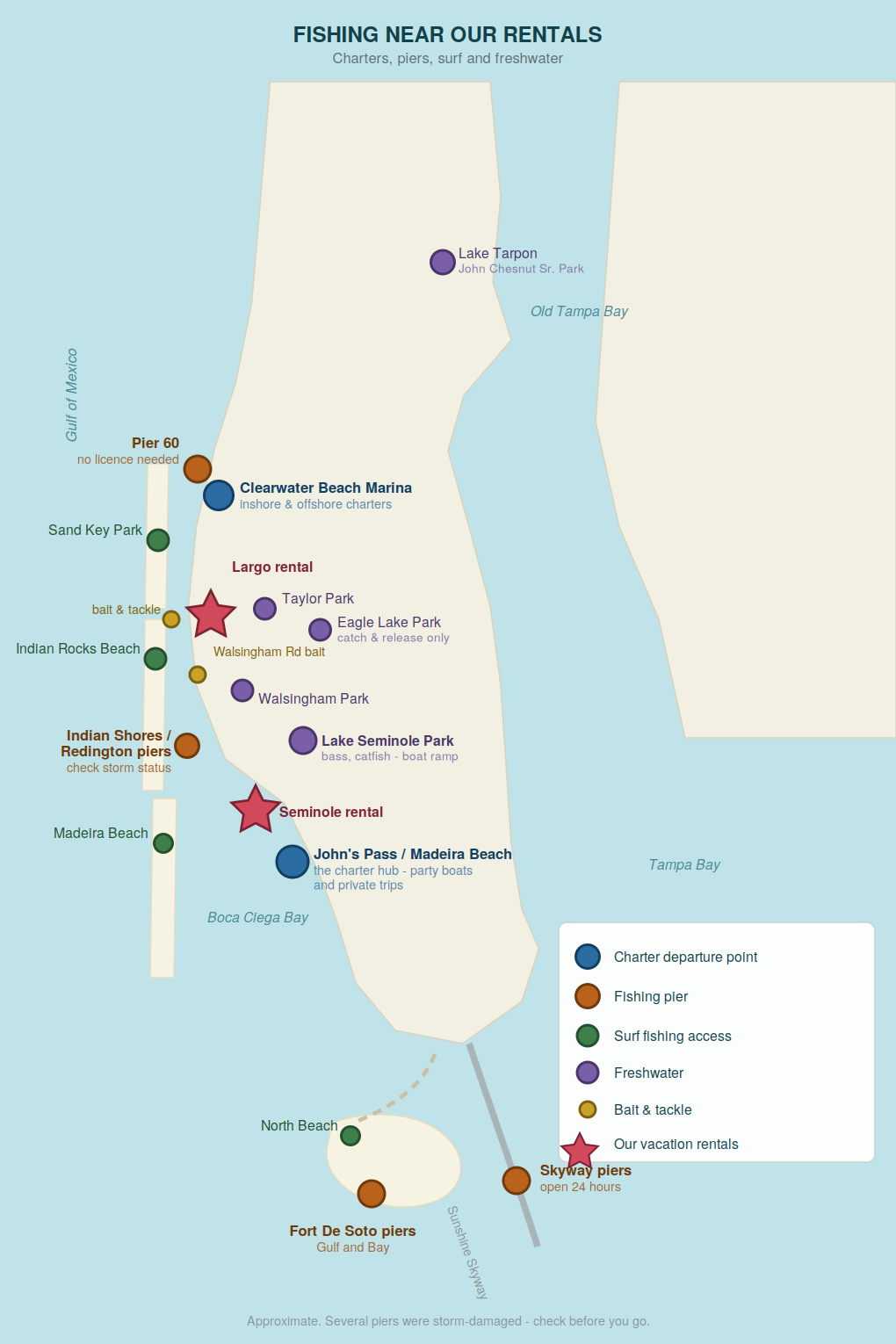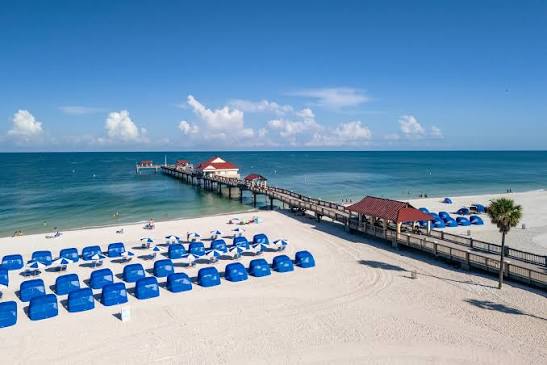
Pier 60 is a 1,080-foot public fishing pier on Clearwater Beach, Florida, offering year-round saltwater fishing without requiring a personal fishing license. Rod rentals and bait are available on-site, making it accessible to beginners, families, and experienced anglers alike.
Seasonal catches range from pompano and Spanish mackerel in spring to snook and tarpon in summer, with redfish in fall and sheepshead in winter. The pier’s underwater lights attract fish after dark, and the adjacent sunset festival, beach, and playground provide additional options when fishing slows.
The 1,080-foot icon of Clearwater Beach is one of the most productive and beginner-friendly fishing spots on Florida’s Gulf Coast — no fishing license required, rods available for rent, and a shot at everything from pompano to a nighttime snook.
Why We Love This Place
Pier 60 is that rare thing: a genuine fishing pier that also happens to sit at the center of one of America’s best-known beaches. You can be standing at the rail with a line in the water twenty minutes after leaving the house, without a boat, without a license, and without having bought a single piece of tackle in advance.
What makes it work for guests is how forgiving it is. If you’ve never fished saltwater in your life, you can walk up to the bait house, rent a rod, buy a scoop of frozen bait, and be catching something within the hour — the pilings hold baitfish year-round, and where there’s bait there’s everything else. If you’re a serious angler, the deeper water at the end of the structure and the underwater lights at night put you on real fish. The entry fee covers the license.
And when the fishing goes quiet, you’re still on Clearwater Beach with a sunset festival starting up behind you. It’s hard to have a bad evening out there.
At a Glance
| 📍 Address | 1 Causeway Blvd, Clearwater Beach, FL 33767 |
| 🎣 Fishing License | Not required — the pier’s blanket license covers you |
| 💰 Daily Fishing Fee | Around $10 adults / $8 seniors / $7 kids 15 and under |
| 🚶 Walk-On (no fishing) | About $1 |
| 🎣 Rod Rental | Roughly $8–$10 per day at the bait house |
| 🪱 Frozen Bait | About $5 |
| 🅿️ Parking | Paid lots and garages nearby (pay-by-plate / ParkMobile) |
| ⏱️ Time Needed | 2–4 hours, or all evening |
| 🚗 Distance from Rental | ~10 miles (25–35 minutes, traffic depending) |
| 📞 Bait House | (727) 462-6466 |
Rates and hours have shifted since the 2024 storms — call the bait house before you load the car.
What You’ll Catch
Pier 60 sits right where the Gulf shallows drop off past the beach, which means the cast of characters changes with the season and the time of day. Here’s the rough calendar:
🐟 Spring (March–May)
- Spanish mackerel — fast, toothy, and the most fun a beginner can have on light tackle
- Pompano — prized eating, caught on small jigs bounced along the bottom
- Whiting — reliable, easy, and great for keeping kids interested
☀️ Summer (June–August)
- Snook — the star, especially after dark under the pier lights
- Mangrove snapper — hanging tight to the pilings
- Tarpon — big, dramatic, and mostly a story you’ll tell about the one that broke you off
- Sharks — blacktips and bonnetheads; catch-and-release only
🍂 Fall (September–November)
- Redfish — the fall run is the one locals wait for
- Spanish mackerel — a second push as the bait moves through
- Flounder — on the bottom, near the sand
❄️ Winter (December–February)
- Sheepshead — the striped “convict fish,” caught with fiddler crabs or shrimp right against the pilings
- Pompano — cold snaps push them through
- Black drum and ladyfish — steady action all winter
How to Fish It
🌙 Fish the Lights at Night
This is the single best tip on this page. The pier’s underwater lights pull in baitfish, the baitfish pull in everything else, and the fish stack up along the light lines where the bright water meets the dark. Cast into the shadow just outside the light rather than into the middle of it — that edge is where predators sit and wait. Summer nights are prime for snook, and the crowds thin out considerably after the sunset festival winds down.
🎣 Bring Enough Rod
The deck sits well above the water, so you need a rod with enough backbone to lift a decent fish up and over the rail. A medium to medium-heavy 7-foot spinning setup with 15–20 lb line handles most of what you’ll hook. If you’re renting, the bait house gear is up to the job — just ask them what’s biting and what to use, because they genuinely know.
🪣 Bring a Drop Net
Anything much over a few pounds isn’t coming up on the line alone. A pier drop net (or a friend with one) is the difference between landing a nice fish and watching it snap off at the rail. Regulars are usually generous about lending a hand — ask politely and you’ll usually get help.
🐠 Buy Live Bait When You Can
Frozen bait catches fish. Live bait catches more. Live shrimp is the all-purpose choice; pinfish and greenbacks are the move if you’re targeting snook or something bigger. Many anglers also catch their own baitfish off the pier with a small sabiki rig, which is a fun little side quest for kids.
📏 Know the Rules Before You Keep Anything
Florida size and bag limits change by species and by season, and some species — snook and redfish in particular — have closed periods and slot limits that shift year to year. Check the current FWC regulations before you put anything on ice, and when in doubt, take a photo and let it swim.
Two Rigs That Cover Almost Everything
You don’t need a tackle box full of hardware to fish Pier 60 well. Nearly everything that swims past the pilings can be caught on one of two setups: a free line for fish moving in the water column, and a bottom rig for fish rooting around in the sand. Learn these two and you’re covered year-round.
🎈 The Free Line — For Snook, Mackerel, Tarpon and Snapper
Free-lining means presenting a bait with little or no weight so it swims and drifts naturally in the current. It looks like nothing else in the water, which is exactly the point — it’s the most natural presentation you can make, and it’s what regulars use when they’re targeting the good fish.
How to tie it:
- Main line: 15–20 lb braid or mono
- Tie on 2–3 feet of 25–40 lb fluorocarbon leader (double uni or FG knot)
- Finish with a 2/0 to 4/0 circle hook, tied with a loop knot so the bait swims freely
- Add no weight at all, or a single small split shot if the current is pushing your bait back toward the pilings
How to fish it: Hook a live shrimp through the horn (avoiding the dark spot), or a pinfish or greenback through the nose or just ahead of the dorsal. Cast up-current and let the bait drift back naturally, feeding line so it doesn’t drag. When something eats, don’t swing — circle hooks set themselves. Just reel steadily until the rod loads up.
Why fluorocarbon: snook are leader-shy in clear water, so lighter is better — but mangrove snapper and anything near barnacle-covered pilings will part light line instantly. Forty pound is a reasonable compromise at night; drop to 25–30 in bright daylight.
For Spanish mackerel: they will cut straight through fluorocarbon. Either accept you’ll lose some hooks, or add a short 6-inch trace of light single-strand wire. A long-shank hook helps keep their teeth off the leader too.
🎣 The Knocker Rig — A Free Line with a Little Help
When the current is too strong to free-line but you still want the bait near the pilings, slide a 1/4 to 1/2 oz egg sinker directly onto the leader so it rides right down against the hook eye. It gets the bait down fast, stays snag-resistant, and the fish still feels almost no resistance when it picks up. This is the go-to rig for mangrove snapper tight to the structure.
⚓ The Bottom Rig — For Pompano, Whiting, Sheepshead, Redfish and Flounder
Anything feeding on or near the sand wants a bait held down there. Two variations cover it.
The double dropper loop (pompano rig) — the workhorse for pompano and whiting:
- Take about 3 feet of 20–30 lb mono leader
- Tie two dropper loops, spaced roughly 10–12 inches apart
- Attach a 1/0 to 2/0 circle hook to each loop
- Tie a 1 to 3 oz pyramid or bank sinker to the bottom of the leader
- Swivel at the top, connected to your main line
Bait both hooks with sand fleas, small shrimp pieces, or FishBites, cast out past the breakers, and keep just enough tension to feel the tap. Two hooks means two chances per cast — and doubles are common when whiting are thick.
The fish-finder (Carolina) rig — for bigger fish that need to run before they commit:
- Slide an egg sinker (1–3 oz) onto your main line
- Tie the main line to a barrel swivel — the sinker now stops there and slides freely above it
- Add 18–24 inches of 30–50 lb fluorocarbon leader
- Finish with a 3/0 to 5/0 circle hook
The sliding sinker is the whole trick: a redfish or black drum can pick up the bait and move off without feeling the weight. Bait with cut bait, a whole live shrimp, or a chunk of mullet, set the rod in a holder, and wait for the rod tip to load.
🦀 The Sheepshead Setup — A Special Case
Sheepshead are the exception to everything above. They live vertically against the pilings, they have human-looking teeth built for crushing barnacles, and they steal bait so delicately that most people never feel the bite.
Fish a small, strong hook — a 1/0 or 2/0 live-bait hook, nothing bigger — with a 1/2 to 1 oz weight pinched or crimped a foot above it. Bait with a fiddler crab, a piece of oyster, or a small chunk of shrimp. Drop it straight down and let it hang beside the piling. When you think you feel something, you’re already late — set the hook on any change in weight or tension at all. Winter is the season for these, and they’re outstanding on the table if you can get past the filleting.
🪝 Three Knots Worth Knowing
- Loop knot (non-slip mono loop) — for free-lining, so the bait or lure swings freely
- Dropper loop — the whole basis of the bottom rig
- Double uni — joins main line to leader, easy to tie in the dark with cold hands
If you’d rather not tie anything, the bait house sells pre-made pompano rigs and leaders. There’s no shame in it — plenty of regulars buy them too.
Great for Beginners and Families
✓ No fishing license needed — the pier’s blanket license covers everyone on it
✓ Rent everything on-site — no need to travel with gear
✓ Something always biting — even a slow day produces small fish, which is what kids actually want
✓ Restrooms and snacks — a short walk away, not a hike
✓ Cleaning stations — handle your catch right there
✓ Built-in backup plan — playground, beach, and the sunset festival are all steps away if the crew loses interest
✓ Friendly regulars — ask what they’re using; most are happy to tell you
Guest Tip: “We went out about an hour before sunset with two rented rods and the kids caught fish almost immediately. Stayed for the festival afterward and it turned into the best night of the trip.” – Recent guest
Know Before You Go
What to Bring
- Cash — simplest way to handle fees, bait, and rentals
- A rag or small towel — you will touch bait, and then you will touch your phone
- Pliers or a hook remover — mackerel have teeth and no manners
- Sunscreen and a hat — there is very little shade on a pier
- Water — more than you think, especially in summer
- A cooler with ice — if you plan to keep anything
- A light jacket for night fishing — the wind off the Gulf gets surprisingly cool
Important Notes
🏗️ Storm recovery is ongoing. Hurricanes Helene and Milton damaged the pier badly in 2024, and it reopened in stages beginning in late 2025. Sections may still be closed and fees may differ from what’s posted online — the bait house is the reliable source.
🅿️ Parking is the hard part. Clearwater Beach parking is paid, limited, and fills up early on weekends and holidays. Arrive early, or come in the evening as the beach crowd clears out. The city uses pay-by-plate and the ParkMobile app.
🎣 Pier etiquette matters. Don’t cast over someone else’s line, give people room, and if a fish runs down the rail, everyone reels in to let it through. It’s a shared space and it works because people cooperate.
🐦 Watch for pelicans. They will absolutely try to take your bait mid-cast, and a hooked pelican is a bad afternoon for everyone. Don’t feed them, don’t leave scraps on the deck, and cast with an eye up.
Best Times to Fish
Dawn (first light to about 9am) — Cooler, calmer, and the most consistent bite of the day
Two hours either side of a tide change — Moving water beats slack water every time; check a tide chart before you pick your window
After dark (especially summer) — The lights turn the pier into a different place; best odds at a big snook
Weekdays — Far more elbow room at the rail than a Saturday
Nearby Attractions
Pier 60 sits at the heart of Clearwater Beach, so you’re never short of a next stop:
- Sunsets at Pier 60 Festival — Nightly, two hours before to two hours after sunset. Street performers, craft vendors, and the sunset itself. Free.
- Pier 60 Park playground — One of the largest beach playgrounds on the Gulf Coast
- Clearwater Beach — Right there, with lifeguards on duty during the day
- Clearwater Marine Aquarium — A short drive back across the causeway
Driving Directions from Our Vacation Rental
From: 1731 Clearwater Harbor Dr, Largo, FL
To: Pier 60, 1 Causeway Blvd, Clearwater Beach, FL 33767
Distance: Approximately 10 miles
Drive Time: 25–35 minutes depending on beach traffic
The Scenic Coastal Route
- Head to Gulf Blvd and turn north
- Follow Gulf Blvd north through Indian Rocks Beach and Belleair Beach
- Continue over the Sand Key Bridge onto Clearwater Beach
- Gulf Blvd becomes Coronado Dr as you enter the beach roundabout area
- Pier 60 is at the west end of Causeway Blvd, at the main beach entrance
- Park in one of the beach lots or garages and walk to the pier
📱 Google Maps: Click here for GPS directions
Tip: the coastal route is prettier but slower in season. If you’re chasing a dawn bite, the inland route up Belleair Rd to Gulf-to-Bay is usually quicker.
Contact Information
Pier 60 Bait House
1 Causeway Blvd
Clearwater Beach, FL 33767
Phone: (727) 462-6466
Pier 60 Park (City of Clearwater)
370 Mandalay Ave, Clearwater, FL 33767
Phone: (727) 444-8270
Park Hours: 7am–9pm daily
Tight lines! If you land something worth bragging about during your stay, we’d love to see the photo.