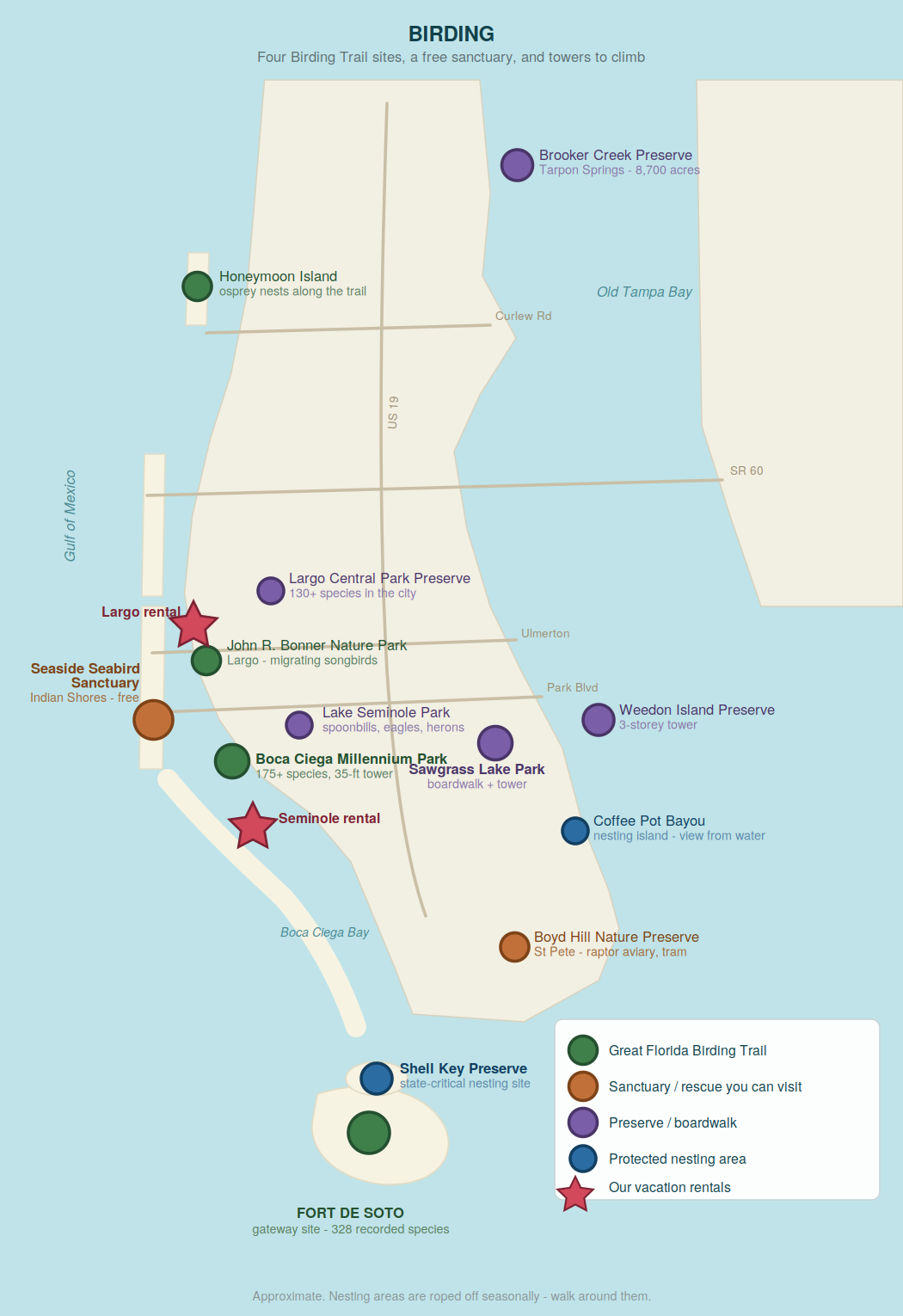
Pinellas County has four Great Florida Birding Trail sites, a park with 328 recorded species, three observation towers you can climb, and a free seabird hospital on Gulf Blvd where a rescued bald eagle sits a few feet away. If you’ve never given birding a go, this is a good place to start — and if you have, bring the long lens.
Start Here
🦅 Seaside Seabird Sanctuary — minutes from both our places, and free
18328 Gulf Blvd, Indian Shores. Open 9am to 5pm, every day. No admission charge — donations only.
This is the one we’d send anyone to first, birder or not. It’s a working rescue and rehabilitation centre for seabirds and raptors, right on the beach side of Gulf Blvd. Birds that can’t be released live here permanently, and the enclosures put you close — pelicans, egrets and herons wander near the entrance, and residents include a bald eagle, red-tailed and short-tailed hawks, turkey vultures, and screech, barn and great horned owls.
Wild birds treat it as a safe place too, so there are pelicans nesting in the trees and flocks of terns and skimmers standing on the beach just beyond. Volunteers are described as consistently friendly and knowledgeable, and 4.8 stars across more than 2,200 reviews says the rest.
Two practical notes: parking is tight, so take care pulling in. And it’s free, which means it runs on donations and gift-shop sales — visitors who go regularly say they give ten or twenty dollars each time. Worth doing.
The Map
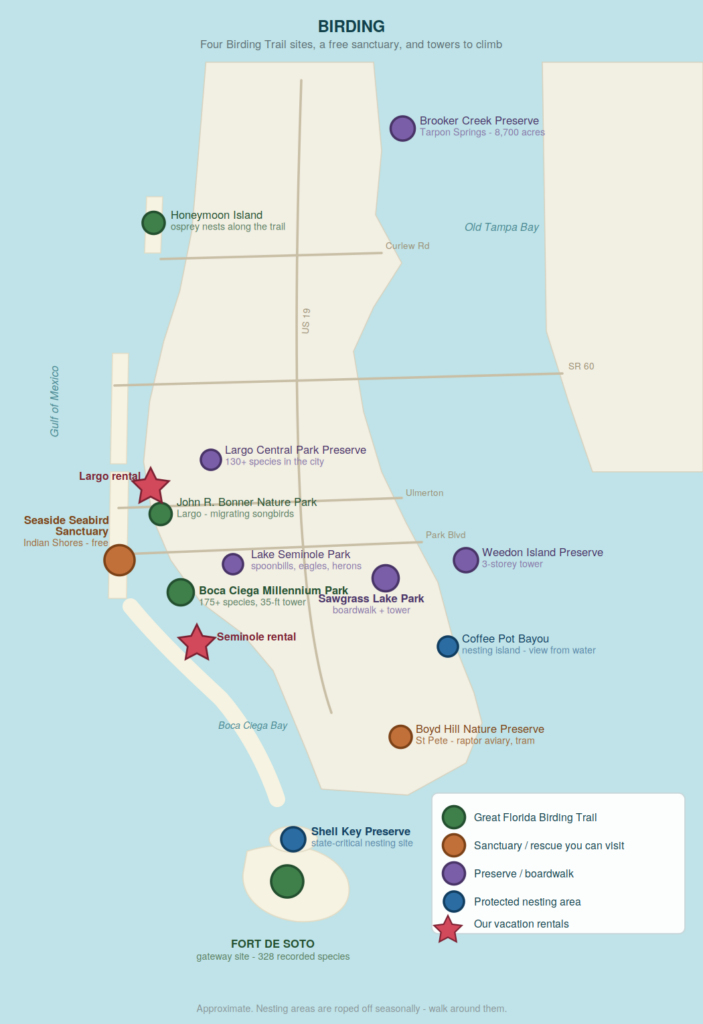
The Great Florida Birding Trail Sites
Four official sites sit within reach, and one is a designated gateway site — the top tier.
🥇 Fort De Soto Park — the serious one
A gateway site for the Great Florida Birding Trail, with over 328 documented species. Five keys, seven miles of shoreline, mangroves, tidal flats and upland habitat, all in one park. Expect pelicans, ospreys, herons and shorebirds in abundance, plus gopher tortoises on the uplands and dolphins offshore.
It’s also one of the country’s better-known spring migration spots — exhausted migrants make landfall here after crossing the Gulf, and April can be extraordinary. Around an hour south, and a few dollars to park all day.
🔭 Boca Ciega Millennium Park — two miles from our Seminole place
175-plus recorded species across seven habitats — pine flatwoods, coastal oak hammock, mangrove swamp, salt marsh, bayheads and freshwater wetlands, all in 186 acres. The 35-foot observation tower gives you a canopy-level view over Boca Ciega Bay, and the boardwalks put you inside the mangroves.
Best route for birds: the ponds first from the first parking area — white ibis, little blue heron, and river otters — then the boardwalk through the mangroves, then the tower for the wide view.
👉 Our full Boca Ciega Millennium Park guide
🐦 John R. Bonner Nature Park — Largo
An official Birding Trail stop and, as we’ve written before, one of Largo’s genuinely best-kept secrets — a quiet coastal preserve on the Intracoastal for migrating songbirds and wading birds. Small, close, and almost always empty.
👉 Our full John R. Bonner Nature Park guide
🦴 Honeymoon Island State Park
Drive-in access, and the Osprey Trail is the draw — a pine flatwoods trail with active osprey nests visible from the path, plus shorebirds along the beach and the rocky stretches. Entry fee applies.
Towers and Boardwalks
Three places where you can get above the canopy, which changes what you see entirely.
🌳 Weedon Island Preserve — a three-storey tower
1800 Weedon Dr NE, St. Petersburg. Free. Boardwalks through mangroves on Tampa Bay, a tall observation tower, and a cultural and natural history centre. Gopher tortoises sunning by the entrance, wading birds on the flats. No pets. Bring bug spray — this is real mangrove.
👉 You can also paddle the mangrove tunnels here
🍁 Sawgrass Lake Park — maple swamp
7400 25th St N, St. Petersburg. A mile or so of raised boardwalk through one of the largest maple swamps on the Gulf coast, an observation tower about half a mile in, and an unusually high hit rate for alligators and snapping turtles alongside ibis and moorhens. Shaded, benches every hundred yards, and free.
Two notes: the boardwalk was rebuilt after the 2024 hurricanes and is in good shape. And access is through a residential neighbourhood — when your GPS tells you to turn into what looks like someone’s street, it’s right.
🌲 Brooker Creek Preserve — 8,700 acres
3940 Keystone Rd, Tarpon Springs. The county’s largest natural area by a wide margin, and free. Miles of interconnecting trails, boardwalk sections, deer, turkeys, butterflies and a wide bird list. The Environmental Education Center is excellent for children — hands-on stations, a Thursday storytime, and a small nature shop.
Important: the education centre is open Thursday to Sunday only. The trails at the separate Friends Trail entrance on Lora Lane are open daily from 7am, with a 1.75-mile loop and an observation tower. No dogs anywhere in the preserve.
Protected Nesting Areas
🏝️ Shell Key Preserve
Designated one of the state’s most important areas for shorebird nesting and wintering, and an active research site. Reachable only by boat — shuttle from Pass-a-Grille, ferry from Fort De Soto, or by kayak.
Rules matter here: part of the mid-island area is a Bird Preservation Area and is off limits entirely. No dogs and no alcohol anywhere in the preserve, and no restrooms. Stay in the marked public use areas, and give roped-off zones a wide berth.
👉 Our shelling guide covers getting there
🦩 Coffee Pot Bayou, St. Petersburg
A small island packed with nesting pelicans, egrets and more, in a residential bayou. You cannot land on it, for obvious reasons — view it from a kayak, paddleboard or boat, or from the shoreline path opposite. Startlingly good for how urban the setting is.
Closer to Home
Several places we’ve already written up are genuinely good birding without being marketed that way:
- Largo Central Park Nature Preserve — 31 acres almost surrounded by water, over 130 bird species, plus alligators and otters, in the middle of the city and free. Our guide
- Lake Seminole Park — a designated wildlife habitat and sanctuary. Visitors regularly report roseate spoonbills, great herons and ibis on the ponds, plus bald eagles, hawks and black vultures. Our guide
- Eagle Lake Park, Largo — named for the eagles that nested there. Wading birds on the lakes, and the boardwalks over the wetlands are the productive bit. Our guide
- Walsingham Park, Seminole — five delineated habitats, and a bird list including hawks, mottled ducks, herons, wrens, thrashers and warblers.
- Moccasin Lake Nature Park, Clearwater — boardwalks over cypress and old oak canopy. Our guide
- Mobbly Bayou Wilderness Preserve, Oldsmar — 396 acres of mangrove channels and wilderness at the top of Tampa Bay. Our guide
- Philippe Park, Safety Harbor — ancient oaks and a Tampa Bay shoreline. Our guide
- Turtle Park (George C. McGough Nature Park), Largo — rescued birds of prey on site alongside the turtles. Our guide
Worth the Drive
- Boyd Hill Nature Preserve, St. Petersburg — a modest admission fee, a cheap guided tram tour, live animal demonstrations, and an estuary aviary of rescued birds of prey. Hosts an annual Raptor Fest. Closed Mondays.
- Anclote Key Preserve State Park — boat access only from Tarpon Springs, and an important nesting island.
- Caladesi Island — ferry-only, undeveloped, and quiet enough that the birds don’t move off.
When and How
📅 Winter Is the Season
Roughly November through April is peak: wintering waterfowl and shorebirds arrive, resident species are still here, and the weather is pleasant all day. Spring migration in late March and April is the highlight for songbirds, particularly at Fort De Soto. Summer is quieter, hotter and buggier, though nesting activity is at its peak.
🌅 Early Morning, Always
First light to about three hours after is when birds are most active and most vocal. It’s also the coolest part of the day and the quietest in terms of other visitors.
🌊 Work the Tide
For shorebirds, a falling or low tide exposes flats and concentrates feeding birds where you can see them. High tide pushes them into roosts. Fort De Soto and Shell Key both reward tide-planning.
🦟 Bug Spray and Long Sleeves
Mangrove and swamp boardwalks at dawn are exactly where mosquitoes are. Weedon Island, Sawgrass Lake and Boca Ciega all warrant it.
🐊 Watch the Water’s Edge
Alligators are present at Sawgrass Lake, Lake Seminole, Walsingham and Largo Central Park. Stay on the boardwalks and keep back from banks.
🐕 Dogs Are Often Not Welcome
No dogs at Weedon Island, Brooker Creek or Shell Key. County parks generally allow leashed dogs but not on boardwalks or observation towers — which rules out the best parts of several sites.
👉 Our dog parks page for where they can go
🪶 Respect the Ropes
Nesting shorebirds abandon nests when disturbed and the eggs cook in minutes. Roped-off areas are not suggestions. This matters most from spring through late summer.
Official Information
- Great Florida Birding & Wildlife Trail — every official site, with what to look for at each.
- Seaside Seabird Sanctuary — hours, and how to donate.
- Fort De Soto Park
- Shell Key Preserve — nesting rules and off-limits areas.
- Weedon Island Preserve
- Sawgrass Lake Park
- Brooker Creek Preserve — education centre days and trail access.
- Honeymoon Island State Park
- eBird hotspots — recent sightings at every site on this page, updated daily. The single most useful tool.
- FWC wildlife viewing
We are not affiliated with any of the parks, sanctuaries or organisations listed here.
From Our Rentals
Our Largo rental (1731 Clearwater Harbor Dr): the Seaside Seabird Sanctuary is a few minutes south on Gulf Blvd. John R. Bonner and Largo Central Park are both close, Eagle Lake and Walsingham inside fifteen minutes.
Our Seminole rental (13189 87th Ave N): Boca Ciega Millennium Park is two miles, the Seabird Sanctuary about ten minutes west, Lake Seminole and Walsingham both close.
Fort De Soto and Shell Key are around an hour south; Weedon Island and Sawgrass Lake about thirty minutes east.
Coming for the birds? November to April is the season, and it’s also our quietest and cheapest. Ask us and we’ll tell you what’s been about.